On July 2,
1776, the Continental Congress voted for independence from Great Britain. The
vote was publicly announced two days later on July 4, prompting celebrations
and fireworks. The first organized observance of the Fourth took place a year
later in Philadelphia, and the custom of celebrating Independence Day and our
democracy quickly spread to other towns.
The
tradition was brought to Lake County, Illinois by non-Native settlers from the
northeastern United States. Many of those settlers had fathers, uncles and
older brothers who had fought in the Revolutionary War.
Lake County became home to two Revolutionary War veterans—Henry Collins of
Massachusetts and Reuben Hill of Connecticut.
Henry Collins marker, Mount Rest Cemetery. Photo: CVal 2021. Reuben Hill marker,
Wauconda Cemetery. Photo: Cindy Graff 2015.
Collins (1763–1847) enlisted at the age of 13 and
served in Captain Newton’s Company and Colonel Cushing’s Regiment. He moved to
British Columbia, Canada, and then came to Lake County with his son, Edward
Henry Collins and his family, settling in Rosecrans. Reuben Hill (1765–1858) came west with his son, Seth
Hill and his family in 1844 and settled in Wauconda by 1845. Hill served from
1780–1783 with the 4th New
York Regiment and fought at the Battle Yorktown (September–October 1781). From
1926–1928, the Daughters of the American
Revolution marked the veterans’ graves to ensure their service to the nation would
be remembered.
Waukegan Weekly Gazette, July 1, 1882.
The first recorded Fourth of July celebration in Lake County took place in Vardin's Grove (today's Libertyville) in 1836—sixty years after the Declaration of Independence was signed. A handful of settlers gathered to celebrate the day, and erected a tall wooden pole known as a "liberty pole" and named their community, Independence Grove.
In 1840, Antioch celebrated their first Fourth. At the time, Lake County was home to just 2,634 residents.
Hiram
Butrick (1811–1886)
of Massachusetts was given the honor of reading the Declaration. He was likely chosen
because he built a sawmill on Sequoit Creek in 1839, which helped the community
prosper.
Elijah M.
Haines (1822–1889), politician, historian, and founder of Hainesville, also attended
the Antioch celebration. He wrote that the day was celebrated “with a barbeque”
and that “a good band of martial music was in attendance to give life and
spirit to the occasion.”
Recollections of July 4, 1844, Waukegan Daily Sun, July 3, 1918.
In 1844, a Fourth of
July picnic was held between Third Lake and Druce Lake west of today’s Route 45.
About 100 people attended, including the
county’s first African American settler, Amos Bennett, and his family. The
celebratory picnic dinner featured fish chowder and pumpkin pie. Also in
attendance was a 13-year old Benjamin Franklin Shepard (1831–1920) of Massachusetts, whose parents proudly
named him for one of the nation’s founders.
A log wagon
festooned with American flags provided a decorative and patriotic speakers’
stand. Reverend William B. Dodge (1782–1869) of the
Millburn Congregational Church offered a prayer for the freedom of the enslaved
men and women in this “free and enlightened” nation. Nathaniel P. Dowst (1817–1854) of Waukegan read the
Declaration of Independence.
Fourth of July celebration announcement. Waukegan Weekly Gazette, July 29, 1861.
The start
of the American Civil War in April 1861 magnified Lake County’s patriotism. That
year the Fourth was celebrated with exuberance in Waukegan “as never celebrated
before.” An advertisement for the event noted that “The bells of the city will
be rung.”
Since the Fourth
landed on a Thursday, the organizers announced that “everybody in the county is
invited and particularly the Public Schools, accompanied by their teachers.”
There was a
large procession from the courthouse at 9 am, and all those on horseback and in
carriages were invited to join. Merchants also agreed to close their shops so everyone
could attend the festivities.
After the end
of the Civil War in 1865, a large Fourth of July gathering was held at Druce
Lake. Susie Smith (1839-1914) of Millburn noted in her diary, “Hurrah: What a 4th of July
we are going to have to day.” Coincidentally, the celebration took
place near the site where Amos Bennett and Rev. Dodge had gathered with their
neighbors over two decades before.
Announcement for the Fourth of July gathering at Druce Lake. Waukegan Weekly Gazette, June 24, 1865.
For Smith this gathering was much more than a commemoration of the nation’s birth. It was a community celebration for the return of the soldiers, including her brother, George. She wrote: “O, so thankfully … by our sides sat those brave hero boys who, one year ago, were engaged amid the din and cloud of battle fighting for their much-loved country … [they] sang with us again beneath our own ‘Star Spangled Banner.’"
Susie Smith's handwritten account of the 4th of July gathering at Druce Lake in 1865. Dunn Museum 93.45.290.
"The Rays" newsletter masthead for July, 1943. Ray Brothers Resort, Diamond Lake. Dunn Museum, 96.1.50
Celebrate America's 250th at the Lake County Forest Preserves: www.LCFPD.org/250
D. Dretske, Curator, ddretske@lcfpd.org
Sources: Lake
County History Archives, Bess Bower Dunn Museum, Libertyville, Illinois www.LCFPD.org/museum Ancestry.com
Newspapers.com “Only Revolution
Soldier Buried in Lake County Joined When 13 Years Old,” Waukegan Daily Sun, August 17, 1911. “Grave of Hero of 1776
Found in Lake County,” Waukegan Daily
Sun, June 1, 1926. “Another Grave of
Revolutionary Veteran Located,” Waukegan
Daily Sun, June 3, 1926. “To Unveil Marker,
Henry Collins’ Grave,” Waukegan Daily Sun,
June 9, 1928. Haines, Elijah M. Historical and Statistical Sketches, of Lake County, State of Illinois. Waukegan: E.G. Howe, 1852. “Tells of First 4th Celebration Here 74 Years Ago,” Waukegan Daily Sun, July 3, 1918. “The Day We Celebrate!
The Fourth at Waukegan,” Waukegan Weekly
Gazette, June 29, 1861. “4th of July at Druce’s
Lake,” Waukegan Weekly Gazette,June 24, 1865. Susannah “Susie”
Smith Diary, Bess Bower Dunn Museum.
"The Rays," newsletter, July 1943. Bess Bower Dunn Museum.
Viking boat treehouse built by Gerald W. Lyons at 17 Washington Park, Waukegan, IL. November, 1963.
News-Sun Collection, Dunn Museum.
To a kid in Waukegan, the Viking boat treehouse felt like something out of a storybook. I was one of those kids,
standing at Shirl’s Drive-In with an ice cream cone in my hand and staring in
awe at the ship perched high in a tree.
In 1963, Gerald W. Lyons (1931-2022) of Waukegan created a treehouse for his four children. It was no ordinary treehouse, but one that sparked the imagination of an entire community.
The Viking boat treehouse project began
when Gerald and Margaret Lyons’ children asked for a “tree-top house like the
one on television.”
It’s likely they had seen Disneyland’s
Swiss Family Treehouse on NBC’s Walt Disney's Wonderful World of Color (1961–69).
Disney’s film Swiss Family Robinson introduced treehouses to a wide audience
and inspired a popular attraction at Disneyland’s Adventureland.
Poster for the "Swiss Family Treehouse" in Disneyland's Adventureland, circa 1962.
During this era, children throughout
the United States built tree houses in local woodlots—some with the help of
their parents—but always with the goal of having a place of their own where
their imaginations could run wild. These treehouses were often made simply with
plywood and cardboard in a tree’s canopy, creating a place to sit and dream.
Lyons was in the
midst of carving a “dragon head” for a friend’s boat when his children asked for
the “tree-top house.” Since the friend’s boat never came about, the dragon figurehead
became the spark for building an out of the ordinary treehouse in the shape of a
Viking boat.
The inspiration may have been close to
home. Vikings in Waukegan were a somewhat familiar presence. Not actual
Vikings, of course, but their Swedish descendants.
Headline announcing the Independent Order of Vikings convention in Waukegan.
Waukegan Daily Sun, August 7, 1915. Newspaper.com
The earliest wave of Swedes arrived in
Waukegan in 1891 with the opening of the Washburn & Moen Wire Mill. Their
community gatherings featured music, food and a “Swedish Glee Club.”
In 1949, the club built a sprawling
clubhouse on Belvidere Road next to Roosevelt Park. It offered entertainment, music
and fish dinners that were open to the public. The clubhouse became a local
favorite; and the Gerald Lyons family may have enjoyed fish dinners there.
Lyons, who worked in Waukegan for the
Elgin, Joliet & Eastern Railway as a yardmaster, considered himself a “jack
of all trades, master of some.” Though he had no experience building a Viking boat,
he had watched ship builders in Portugal while serving as a U.S. Navy
photographer.
“Boats in the water are more trouble
than they’re worth,” Lyons told News Sun staff writer Carl Luomala. He decided
to build the 24-foot Viking boat perched on top of a 20-foot-tall stump of an
old poplar tree in the family’s backyard at 17 Washington Park. It was as
impressive as it sounds.
Perhaps
Gerald Lyons’ Irish ancestors had a bit of Viking blood in their veins. After
all, the Vikings invaded Ireland in the 9th century. His paternal
grandfather, Edward J. Lyons (1877–1963), immigrated from Ireland in 1895, and opened
a plumbing shop in Waukegan.
News-Sun Staff photo of Gerald Lyons building his Viking boat treehouse in July 1963.
News-Sun Collection, Dunn Museum.
The Lyons’ backyard sat next to an
alley that led to the Shirl’s Drive-In parking lot. Shirl’s, located at 1535
Washington St. (today’s Poppy’s), had a direct view of the neighborhood
curiosity as it was taking shape in July 1963.
Lyons’ Viking boat treehouse was built
for his family, but its towering presence made it a cultural icon the entire community
enjoyed. His creativity and imagination brought the community together.
Those who stopped at Shirl’s Drive-In to
enjoy a soft-serve ice cream cone with family or friends would stand in the
parking lot marveling at the towering Viking boat next door. The more adventurous
walked a short distance to the alley for a closer look. As one of those
adventurers, I can attest to how our imaginations ran wild as we pondered that glorious
oddity.
Gerald and Margaret Lyons with their four children in the Viking boat treehouse. News-Sun Staff photo, November 1963.
News-Sun Collection, Dunn Museum.
Thanks to the News-Sun story,
“He Builds His Boat… In a Tree!” from November 28, 1963, we have a record of
this marvelous creation. What became of the Viking treehouse, however, remains
unknown.
If you have memories of it—or know
what eventually happened to the boat—I’d love to hear from you.
- Diana Dretske, Curator, ddretske@lcfpd.org
For more about Lake County residents
and their fascination with Vikings, check out my Vikings
in Lake County blog post.
Promotional photo for Cora Folsom Salisbury and Jack Benny, circa 1911.
In Lake County's entertainment history, “the man from Waukegan,” Jack Benny,
takes center stage. But where would Benny have been without his “irresistibly
funny” vaudeville mentor, Cora Salisbury?
Years
before settling in Waukegan and teaming up with Benny, Cora Salisbury enjoyed
fame on the vaudeville circuit.
Vaudeville
entertainment was popular from the mid-1890s to the early 1930s. Most
vaudeville acts were part of a troupe of about a dozen individuals who traveled
from town to town. Their acts included magic, acrobatics, juggling, comedy,
music, song and dance, and trained animals.
Cora was
born to Eliza A. Knofsker and James H. “Harry” Folsom on February 13, 1868, in
Oshkosh, Wisconsin. Her father’s untimely death in 1883 prompted her mother to earn
a living providing meals and lodging in their home. Many of their boarders were
part of traveling theatrical troupes. These artists inspired a teenage Cora to
learn about contemporary music and the stage, leading her to pursue a career as
a musician and entertainer.
One of Cora Folsom Salisbury's first public performances was
noted
in The Oshkosh
Northwestern, Wisconsin newspaper on April 15, 1887.
In 1888,
Cora married newspaperman Charles P. Salisbury, who changed careers to manage theaters
and a musical theater troupe in New York. In 1892, Cora began performing with
the troupe as a pianist and elocutionist—using her voice, gestures, and comedic
timing to entertain.
In 1903, after
divorcing her husband for “non-support,” she set out on a solo tour of
vaudeville houses in the upper Midwest as Miss Cora Folsom Salisbury. Her act
featured an “artistic pianologue” that blended comedy with her original ragtime
piano compositions.
On her
return to Oshkosh in late 1907, the local newspaper heralded her success: “Miss
Salisbury has an act that is absolutely new. It is also irresistibly funny. She
is a good-looking little woman, but is willing to sacrifice her good looks and
graceful carriage at times to amuse the public.”
Publicity for the talented pianist and composer Cora Folsom Salisbury's
debut at the Barrison Theater. Waukegan Daily Sun, June 25, 1908.
After 16
years on the vaudeville circuit, Cora had a chance to settle down. In
April 1908, she moved to Waukegan to become the musical director for the recently
opened Barrison Theatre on Sheridan Road. There, her knowledge of music and
performance was admired.
The Barrison Theater is shown at left with awning. In addition to her musical work at the Barrison, Salisbury was a Waukegan Woman's Club member and, in 1915, spoke at the Carnegie Public Library (right) on the history of musical instruments. Postcard, circa 1908. Dunn Museum 61.8.101.
In the musical
director position, Cora performed as a pianist with Barrison’s
orchestra and as a solo act. Her role also included playing music for each
artist’s act along with “subtle interpretation” piano accompaniment during the showing of silent
motion picture films.
The Waukegan
Daily Sun gushed at her first solo performance on June 25, 1908, stating,
“She is a vaudeville artist of rare talent, of charming stage mannerisms… We
feel she belongs to Waukegan.”
Waukegan Daily Sun, June 22, 1908.
On that
same night, the Waukegan Junior Orchestra played at the Barrison. Among its
musicians was a 14-year-old Benjamin Kubelsky on violin. This was possibly the
first time Cora Salisbury met the future Jack Benny.
In January
1909, “Bennie Kubelsky” made his debut performance as an act at the Barrison.
The following year, he joined the Barrison Orchestra under Salisbury’s
direction.
Waukegan Daily Sun, November 28, 1910.
In 1910, three vaudeville theaters in Waukegan merged into the Greater Barrison Vaudeville group, and Cora continued as "musical directress."
In addition
to her work as musical director, Cora composed music and earned an income
from her copyrighted compositions. Before recordings were available, composers
earned a living through sales of their sheet music. In 1911, her “Lemons and Limes Rag”
was a big hit, and “Ghost Dance” was played at the Majestic Theatre in Chicago
and “heralded as the greatest characteristic orchestra number written in
years.”
"Ghost Dance" by Cora Salisbury, 1911. Jenne Ven Antwerpen, YouTube.
Hein’s
department store in Waukegan hired her to “take charge” of its music
department. To promote and sell music, many department stores employed a “song
plugger” to play sheet music for patrons to purchase. Cora Salisbury was among many
noteworthy “pluggers” nationwide, including George Gershwin and Irving Berlin.
Hein's Store ad announcing the addition of Miss Cora Salisbury to its music department.
Waukegan Daily Sun, January 11, 1911.
In February
1911, Cora was the musical director for the Elks Minstrel Show at the
Schwartz Theatre in Waukegan. The Daily Sun wrote that Salisbury is a
“mistress of a sorcery of the keys which carried the entire show through to a
vast success.” Benny Kubelsky, the “rag time violinist,” also appeared at the
show.
Shortly after this
performance, Cora convinced Benny’s parents, Meyer and Emma Kubelsky, to
allow him to tour with her.
That summer,
the duo set out on a coast-to-coast tour with their act “Salisbury and Benny: From
Grand Opera to Rag Time.” The 43-year-old Salisbury enjoyed returning to her
roots while mentoring the promising 17-year-old on his first vaudeville tour. For
their performance at the Bijou Theater in Kenosha, Wisconsin, Benny was billed
as “The Fiddlin Kid.”
On breaks
in 1912 and 1913, they returned to Waukegan, where they performed at Neal’s
Candy Shop and the Hein’s Store.
Publicity photo for "Salisbury and Benny: From Grand Opera to Rag Time." Circa 1912.
In February 1913, a review of Salisbury
and Benny’s performance at the Hippodrome in Lexington, Kentucky, described the
19-year-old Benny as “a rather lazy looking youth." The reviewer went on to say that Benny "holds his violin as if it
might weigh a few hundred pounds, but nevertheless he gets the music… every
time he pulls his bow across the strings, he either gets a howl from his
audience or they sit entranced.”
By early 1914, the pair’s touring and
partnership concluded. The most significant contributing factor was likely the
need for Cora to remain in Waukegan to care for her ailing mother, Eliza. Over the years, Cora had also suffered from bouts of facial neuralgia.
Salisbury suffered from occasional bouts of facial neuralgia, a condition that causes intense pain similar
to an electric
shock on one side of the face. Waukegan Daily Sun, May 20, 1909.
On February 5, Cora
and Benny made one final appearance on the same stage—though as separate
acts—for the Waukegan YMCA’s charity event.
Benny found a new partner in pianist
Lyman Woods. They began touring as “Benny and Woods: From Grand Opera to Rag
Time,” giving Benny top billing and changing Salisbury for Woods.
Publicity photo of Jack Benny taken for his new act "Benny and Woods" at DeHaven Studio,
Chicago, circa 1914.
Dunn Museum 94.34.54
On October 4, 1914, to the surprise of
her friends, and at the age of 46, Cora married Navy Warrant Officer George L.
Aulmann (1867-1939).
Waukegan Daily Sun, October 7, 1914.
Cora Salisbury Aulmann continued as a
pianist and composer at local venues and parties. In March 1915, she gave up her
position at the Barrison Theatre due to her declining health and the strain of
looking after her mother, who passed away later that year.
In January 1916, Cora sold her Schiller
piano and left for sanitariums in Chicago and Fond du Lac, Wisconsin, seeking
to improve her health. On her return trip to Waukegan with her husband, she became
ill with peritonitis and was hospitalized.
On April 16, 1916, Cora Salisbury Aulmann
died at the Jane McAlister Hospital in Waukegan.
Her husband, George Aulmann, noted in the Waukegan Daily Sun after her death: "My wife improved so much under the treatment at Fond du Lac that both she and I were confident that she was going to get well."
Cora Folsom Salisbury, circa 1911. Ragpiano.com.
Cora Salisbury found her home in theater
venues and the laughter and applause of appreciative audiences. She was a
talented vocalist, pianist, and a rare female ragtime composer whose comedic
timing may have influenced Jack Benny’s comedy skits.
Her legacy may best be
remembered in the success of her protégé. Those early years in Waukegan and on
the road with Cora were crucial to Jack Benny’s career. No wonder he
always spoke of his mentor with kindness and gratitude.
Women often held
supporting roles in vaudeville, but Cora Salisbury broke the mold with her
successful solo “pianologue” act and equal partnership with Jack Benny.
Check out the DunnTV Historymakers: Cora Salisbury video on YouTube.
- Diana Dretske, Curator ddretske@LCFPD.org
Sources:
Lake County History Archives, Bess Bower Dunn Museum, Libertyville, Illinois.
MayoClinic.org "Trigeminal Neuralgia Symptoms and Causes."
RagPiano.com
YouTube.com
"A Fine Program," Oshkosh Northwestern, April 15, 1887.
"Salisbury-Folsom: A Quiet Afternoon Marriage at the Home of the Bride," Oshkosh Northwestern, June 6, 1888.
"Here to Get a Divorce: Mrs. Charles P. Salisbury of New York in the City," Oshkosh Northwestern, May 14, 1903.
"Wins Success on Stage: As a 'Pianologist' Mrs. Charles P. Salisbury Makes a Hit in Vaudeville," Oshkosh Northwestern, Nov. 23, 1907.
"Local Musician Gains Fame as a Composer," Waukegan Daily Sun, June 6, 1908.
"Salisbury Intermezzo Is Issued Today: Latest Composition of Barrison Leader," Waukegan Daily Sun, June 16, 1908.
"Cora Salisbury Scores Heavily at Barrison: More Than a Pianist, She is a Great Vaudeville Artist," Waukegan Daily Sun, June 26, 1908.
"Made Such Hit Had to Deliver Curtain Speech," Waukegan Daily Sun, June 27, 1908.
"Makes Her Debut Tonight," Waukegan Daily Sun, June 28, 1908.
"Draw Big Crowds at the Barrison," Waukegan Daily Sun, January 16, 1909.
"Here's a Stage Heroine: Miss Cora Salisbury Suffers of Neuralgia; Plays On," Waukegan Daily Sun, May 20, 1909.
"Gets Offer From Oshkosh: Miss Cora Salisbury Will Remain in Waukegan," Waukegan Daily Sun, May 2, 1910.
"Orchestra Gets Praise," Waukegan Daily Sun, November 28, 1910.
"Miss Salisbury at Hein Store," Waukegan Daily Sun, January 10, 1911.
"Cora and Ben Are Hits at the Bill: Attracting Capacity at Orpheum, Gary, Ind.," Waukegan Daily Sun, September 5, 1911.
"At The Empire," Montgomery Alabama Advertiser, February 25, 1912.
"Tonight Another Fine Musical Show at Bijou," Kenosha News, June 20, 1912.
"Tonight at Opera House Cora Salisbury," Oshkosh Northwestern, October 10, 1912.
"Salisbury and Benny Make Hit at the Hip," The Lexington Herald, February 18, 1913.
"Salisbury and Benny to Perform at Hein Store Supper and Dance," Waukegan Daily Sun, October 30, 1913.
"Charity Concert is Pronounced a Decided Success," Waukegan Daily Sun, February 6, 1914.
"News Today in Brief Form [Salisbury-Aulmann wed]," Waukegan Daily Sun, October 7, 1914.
"Music Department in Meeting Monday at Library Rooms: Mrs. Cora Salisbury-Aulmann Gave a Very Interesting Paper at Meeting," Waukegan Daily Sun, January 26, 1915.
"Benny Kubelsky and Partner [Woods] Head Bill at Barrison," Waukegan Daily Sun, March 23, 1915.
"Cora Salisbury Severes Ties with Barrison," Waukegan Daily Sun, May 17, 1915.
"For Sale: Schiller piano," Waukegan Daily Sun, January 13, 1916.
"Mrs. G.L. Aulmann Passes Away at Hospital Sunday: Better Known as 'Cora Salisbury' Club Woman, Talented Pianist and Composer," Waukegan News Sun, April 17, 1916.
Mary Spoor Brand's illustration for Bobby and Betty With the Workers by Katharine Elizabeth Dopp, published by Rand McNally & Company, 1923.
The Golden Age of American illustration (1880 - 1914) gave women unprecedented opportunities to be employed as illustrators. The momentum it created would benefit Mary Louise Spoor Brand of Waukegan, who became a children's book illustrator in the first decades of the 20th century.
Mary Louise Spoor Brand (1887-1985). Ancestry.com volks1wag family tree.
Known as "Mollie" to her friends and family, Spoor was born on March 15, 1887 to Catherine Stressinger (1853-1947) and Marvin Spoor (1839-1927). Her father was an engineer for the North Western Railway, and except for an absence while serving with the 89th Illinois in the Civil War, Marvin Spoor ran a train between Waukegan and Chicago from the late 1850s until his retirement in 1902.
Growing up in Waukegan, Mollie was surrounded by creative individuals, including her family's neighbor, Edward Amet, who was an early motion picture pioneer and inventor. See my post on Edward Amet. Mollie's brother, George K. Spoor, partnered with Amet in the motion picture business. About 1895, George featured his eight-year old sister, Mollie, in a short film of her playing with ducks.
Mollie Spoor on her high school graduation day, June 1905, at the courthouse in Waukegan. Dunn Museum Collections.
In June 1905, Mollie graduated from Waukegan High School with "high honors" and was chosen class valedictorian for scholarship. Mollie was class treasurer and secretary of the school's drama club. The club's play that spring, "Hamlet," was held at the Schwartz Theater in Waukegan. Mollie Spoor starred as Ophelia alongside her high school sweetheart, Enoch J. Brand, who had the leading role as Hamlet.
Waukegan High School's Class of 1905. Mollie Spoor and Enoch Brand are noted with yellow stars.
Yearbook photo courtesy of Waukegan Historical Society.
Schwartz Theater in Waukegan where Mollie Spoor and her high school classmates presented "Hamlet" in 1905. Photo 1950s. Dunn Museum Collections.
The Waukegan Daily Sun noted that "Miss Spoor has a peculiar ability in executing pretty water colors and drawings, but she has not made any decision as to what she will do in later life." Within a year, Spoor found a path to her future career and enrolled at the School of the Art Institute of Chicago. There she excelled in illustration and portraits.
Mary L. Spoor's illustration featured in "The Art Institute of Chicago Circular of Instruction" for 1909-1910.
In 1907, Mollie's brother, George Spoor and actor/director "Broncho Billy" Anderson, founded a motion picture studio in Chicago. The studio's name—Essanay—was a play on the founders' initials "S and A." See my post on Essanay Studios.
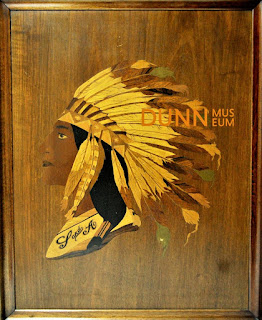
Mollie Spoor's inlaid wood design for Essanay Studio's logo. In 1961, she donated the piece to the Lake County History Museum
(forerunner of the Bess Bower Dunn Museum). 61.33.1 Dunn Museum Collections.
George asked his artistic sister to design the studio's logo. The distinctive choice of a Native American in headdress was likely George's idea, but the design was all Mollie's. Her framed piece was made of inlaid wood and hung in her brother's studio office at 1333 W. Argyle Street in Chicago.
In June 1910, Spoor graduated from the School of the Art Institute with honors. The Waukegan Daily Sun noted that "In every respect she is the ablest artist this city ever claimed... and has won honor after honor at the Chicago Institute."
Waukegan Daily Sun piece celebrating Spoor's accomplishments at the Art Institute, June 18, 1910. Newspapers.com
After graduation, she participated in a month-long Art Institute sketching class that went to the Eagle's Nest Art Colony in Oregon, Illinois. The colony was founded in 1898 by American sculptor Lorado Taft (1861-1936) and consisted of Chicago artists, many of whom were members of the Chicago Art Institute.
"Bye Bye Bunting" illustration by Mary Louise Spoor, 1917. Seesaw.typepad.com.
Mollie made her home in Chicago and her art career took off. Her skill and professionalism was in great demand in the Midwest's publishing hub, where she found work with Rand McNally, Lyons & Carnahan, and Congdon Publishers.
Jack and Jill chromolithograph by Mary Louise Spoor, 1917. treadwaygallery.com
Decades of technical advances in printing and the falling price of paper fueled the "ten-cent magazine revolution," spurring a demand for magazines such as the Ladies' Home Journal, and also children's books. In the late 19th century, books designed solely for children were brought on by the Industrial Revolution and a growing middle class with an awareness of the importance of preserving children's innocence and the benefits of play and amusement.
At the turn of the 20th century, a burgeoning demand for artists continued, and particularly for women artists as illustrators of literature targeted to women and children.
In the midst of this exciting time for illustrators, Mollie Spoor partnered with fellow School of the Art Institute student, Gertrude S. Spaller (1891-1970). The women became friends and colleagues, and worked together for ten years, even sharing an art studio in the tower of the Auditorium Building in Chicago.
Chicago Auditorium Building from Michigan Avenue. Spoor and Spaller's shared studio was located in the tower.
Photo by JW Taylor. Public domain via Wikimedia Commons.
Spaller and Spoor illustrated children's readers titled, The Easy Road to Reading Primer, for Lyons and Carnahan of Chicago/New York.
The Easy Road to Reading, First Reader. This series was illustrated by Mary Louise Spoor and Gertrude S. Spaller.
Published by Lyons and Carnahan, 1919-1925. Seesaw.typepad.com.
Illustrations by Mary Louise Spoor for The Easy Road to Reading series published by Lyons and Carnahan. Seesaw.typepad.com.
Mollie Spoor also illustrated the stories of Katharine Elizabeth Dopp (1863-1944) for Rand McNally's Bobby and Betty children's books. Dopp was a notable American educator. The Bobby and Betty series featured the fictional children at play, at work, and in the country.
Mary Spoor Brand's illustration of "The Milkman and His Horse" written by Katharine E. Dopp for Bobby and Betty With the Workers, 1923.
During her career as an illustrator Spoor appeared under the name Mary Louise Spoor and after her marriage to Enoch J. Brand in August 1915, she was sometimes credited as Mary Spoor Brand.
In many ways, Mollie was ahead of her time as a career woman. Many talented women illustrators gave up their art careers when they married, a societal norm at the time. According to her wedding notice in the Waukegan Daily Sun, Mollie's art "services were in great demand" in Chicago, so much so that she postponed her wedding until she finished a project for Rand McNally.
Ten years after their high school graduation, Mollie Spoor and Enoch Brand wed in Waukegan.
Waukegan Daily News, August 11, 1915. Newspapers.com
Mollie and Enoch moved to Minnesota and then to Massachusetts for Brand's insurance work. Mollie temporarily set aside her career until her four sons were in school, and then returned to illustrating.
In 1922, the family came back to Illinois. They settled in Winnetka where Spoor became an officer in the North Shore Art League (est. 1924), and continued to express herself through her love of art until her death in 1985.
Mollie Spoor's illustrations charmed a multitude of children and parents in the early decades of the 20th century. Her skill as an artist contributed to children's illustrated books being respected as an art form. Today her work has received renewed interest as vintage children's readers have become collector's items.
Mary Spoor Brand illustration from Bobby and Betty with the Workers by Katharine Elizabeth Dopp for Rand McNally, 1923.
- Diana Dretske, Curator ddretske@lcfpd.org
Sources:
"Elect Club Officers," Waukegan Daily Sun, March 22, 1905.
"Earn High Honors," Waukegan Daily Sun, June 22, 1905.
"Miss Molly Spoor Wins High Art Study Honors," Waukegan Daily Sun, June 18, 1910.
"Mary L. Spoor Becomes Bride of Enoch Brand Here," Waukegan Daily Sun, August 11, 1915.
"Marvin Spoor Is Dead After Ailing For Over 25 Years," Waukegan Daily Sun, 1927.
"Enoch J. Brand," Chicago Tribune, October 5, 1948.
"Child Film Star' Mary Brand, 98," Chicago Tribune, October 31, 1985.
- "The Art Institute of Chicago Circular of Instruction of Drawing, Painting, Modeling, Decorative Designing, Normal Instruction, Illustration and Architecture with a Catalogue for Students 1909 - 1910." Chicago: Art Institute of Chicago, 1909.
- Smith Scanlan, Patricia. "'God-gifted girls'": The Rise of Women Illustrators in Late Nineteenth-Century Philadelphia." Nineteenth-Century Gender Studies. http://w.ncgsjournal.com/issue112/scanlan.html
- Goodman, Helen. "Women Illustrators of the Golden Age of American Illustration." Women's Art Journal, Spring-Summer, 1987, Vol. 8, No. 1. Accessed December 1, 2021. https://www.jstor.org/stable/1358335.
- Kosik, Corryn. "Children's Book Illustrators in the Gold Age of Illustration." IllustrationHistory.org.
- Kesaris, Paul L. American Primers: Guide to the Microfiche Collection. Bethesda, Maryland: University Publications of America, 1990.
- Dopp, Katharine Elizabeth. Bobby and Betty With the Workers. Chicago: Rand McNally & Company, 1923.
- Cowan, Liza, ed. "Artist: Mary Louise Spoor." SeeSaw: A Blog by Liza Cowan. February 7, 2012. https://seesaw.typepad.com/blog/artists-mary-louise-spoor/
Special thanks for research assistance to Ann Darrow, Librarian, Waukegan Historical Society www.waukeganhistorical.org; and Corinne Court, Senior Cataloging and Metadata Assistant, School of the Art Institute of Chicago.


%20edit%202.jpg)


The_Oshkosh_Northwestern_15%20April%201887_Page_4_underscore.jpg)