Search This Blog

Tuesday, July 8, 2014

Civil War Veteran - William Bonner

William Bonner, 1841 - 1863
Courtesy of Bonner Family

William Bonner Jr. was one of thousands of Lake County men to enlist in the Civil War. By the summer of 1862, the war had become synonymous with death and privation, but Bonner heeded President Lincoln's call to preserve the Union.

Bonner was the eldest child of Scottish immigrants William and Margaret Bonner. In 1842, the family settled along Sand Lake Road south of Millburn (now part of Lindenhurst). Their farm is preserved by the Lake County Forest Preserves as the Bonner Heritage Farm. (See my post on the Bonner Heritage Farm)

William Bonner, Jr. grew up in this house.
John Bonner (William's brother) and family, circa 1900.
Courtesy of Bonner Family.

William was born in Canada on the family's trip over from Scotland. He grew up on the Bonner's Avon Township farm (shown above), working as a farmer. He most likely attended the one-room Dodge School (which his father William Sr. built) on the southeast corner of Sand Lake Road and Route 45.

The 21-year old William was recruited by John K. Pollock of Millburn into Company C of the 96th Illinois Regiment. On September 2nd, Bonner went to Waukegan to formally enlist in Pollock's Company. He most likely shared the wagon ride to Waukegan with other neighborhood enlistees, including George C. Dodge, and Henry Bater, a laborer on the Bonner's farm. After several days of training the regiment went by train to Camp Fuller in Rockford, Illinois for more intensive training before heading to the front.

During a portion of his first year of service, Private Bonner suffered from "camp illness." Soldiers were commonly sick due to poor sanitation, poor nutrition, and being exposed to a multitude of diseases. Several letters written by William's comrades in the Dunn Museum's collections note his ill health: 

George C. Dodge wrote: "Wm. Bonner don't seem over well now days his legs trouble him considerably." (Letter to David Minto in Millburn, April 17, 1863, from Camp near Franklin, TN - Dunn Museum 93.45.505.2)

"William Bonner has been unwell but is well now he does duty every day," (Letter of Chase Webb to David Minto, May 12, 1863 - Dunn Museum 93.45.519.2)

"William Bonner [is not very well] though he is on duty," (Letter of Captain John K. Pollock to David Minto, May 17, 1863, Franklin, TN - Dunn Museum 93.45.567.2) 


The 96th Illinois' first battle came at Chickamauga, Georgia on September 18 - 20, 1863. This battle claimed the second highest number of casualties of the war after Gettysburg. (See my post on Chickamauga)

The 96th Illinois lost half its men in one day's fighting on September 20. Bonner and his comrades of Company C were given a "terrible blow" while defending the Union's position on Horseshoe Ridge. Of the company's 35 men sent into battle, 25 were wounded and the remaining ten had bullet holes through their clothes and accoutrements.

According to the 96th's regimental history, William Bonner Jr. "was shot through the body" in the first charge on Horseshoe Ridge. He was "left upon the field, doubtless dying within a few hours." Bonner did not make it to the field hospital at the rear, but even if he had the wound was fatal.

For many months Bonner's friends and family clung to the hope that he was alive and would be heard from. The Bonners watched the road for any sign of their son's return home.

One of William's comrades, William Lewin of Newport Township, wrote on December 11, 1863, nearly three months after the battle: "I have not seen any one that has seen or heard any thing of Wm Bonner since the battle of Chickamauga." (below)

No news ever came. 

Excerpt from William Lewin's letter regarding William Bonner.
Dunn Museum 93.45.518.2

On the home front, families often never learned the fate of their loved ones. There was no system to identify the dead, notify families, or compensate them for their loss. William Bonner is one of hundreds of thousands of Civil War soldiers who have remained unidentified and their demise unknown. 

On Sunday, July 13, 2014 at 10 a.m., the Bonner Family will hold a memorial to honor William Bonner, Jr., whose body was never found. The grave marker (cenotaph) dedication is open to the public and will be at the Millburn Cemetery on Millburn Road east of Route 45.


For a list of Civil War veterans buried at Millburn Cemetery follow this link to the Historic Millburn Community Association website.  

Friday, June 20, 2014

Women Artists and the Civil War

Sculptors Edith Freeman Sherman and Lily Tolpo made significant contributions to the county's two  public Civil War monuments in Waukegan. 

Edith Freeman Sherman, circa 1960. News-Sun photo. 

Though no battles were fought here, Lake County gave significant support to the war effort, sending nearly 2,000 men to fight to preserve the Union and ultimately to abolish slavery. Communities rallied around the soldiers, and women coordinated donations of quilts and bandages, and advocated for better care of the sick and wounded.

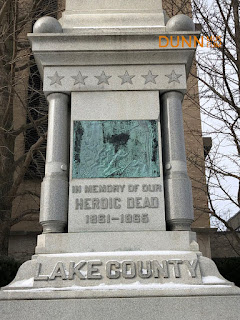
After the war ended in 1865, a Soldiers Monument Association was formed to commemorate the war dead. It would take 34 years to raise enough money to build a monument. Edith Freeman Sherman (1876-1970) was selected to create four bronze panels for the base of the monument; panels depicted the county’s troops in the infantry, artillery, cavalry, and navy. 

Sherman was a talented sculptor and graduate of the School of the Art Institute in Chicago. Her instructor in the Sculpture Department was American sculptor, writer and educator, Lorado Taft. Years later, her fellow alum considered her an "important sculptress" in Chicago. 

One of her most prominent commissions was to create four bronze panels for the sides of the Soldiers and Sailors Monument, which was erected on Waukegan's courthouse square in August 1899. In addition to her talent as a sculptor, her family's connection to the Civil War made her the perfect choice for the commission. 

Edith Sherman's grandfather 1st Lt. Addison B. Partridge (1807-1888), and uncle Sgt. Major Charles A. Partridge (1843-1910) both served in Company C of the 96th Illinois Regiment. Her father, Isaac A. Freeman (1840-1923), served with the 1st Vermont Cavalry. Additionally, uncle Charles was the 96th Illinois' historian and chairman of the monument association. (For more info, read my post on Addison Partridge).

Soldiers and Sailors Monument, Waukegan courthouse square. 
Dedicated August 29, 1899. Dunn Museum 61.8.88.

Soldiers and Sailors Monument with one of Edith Freeman's bronze friezes. Photo D. Dretske, Dunn Museum

The panels Sherman created represented dynamic images of the four aspects of military service during the Civil War. She gave up a summer trip to Europe to do the work, but the commission meant more to her than the vacation. In 1907, she married Edwin T. Sherman and set aside her art career to raise her family. After her husband's death in 1945, Edith returned to a full-time career as an artist. 

Ninety-six years later, Lily Tolpo was commissioned for another Civil War monument.

Lily Tolpo, circa 1960. Online.

Lily Tolpo (1917 - 2015) was the eldest of five children in a Chinese-Polish American family. She learned to play violin and performed as a Vaudeville musician from 1935-39, before becoming a professional artist and sculptor.

Tolpo was commissioned to do a pair of bronze bas relief plaques to complete a project started by her late husband, Carl Tolpo (1901 - 1976).

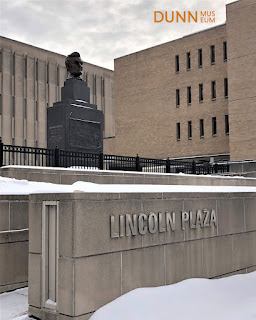
Lincoln Monument west side of county courthouse, Waukegan. Photo D. Dretske, Dunn Museum.

Lincoln monument by Carl Tolpo (1968), bronze plaques by Lily Tolpo (1996).
Lake County courthouse, Waukegan. 


In 1968, Lake County commissioned Carl Tolpo to make one of his famous Lincoln monuments. There were to be two plaques on the sides of the pedestal, but funds were not available to complete the project. The monument remained unfinished for nearly three decades.

Lily Tolpo with one of her clay models for the plaques. The image illustrates Abraham Lincoln's visit to
Waukegan on April 2, 1860. Northwestern Illinois Farmer photo.

In 1995, the county revived the Lincoln monument project and reached out to Lily Tolpo to complete her late husband’s work. Lily Mark Tolpo was an accomplished Lincoln sculptor and artist in her own right, and had previously created a hanging sculpture for the county’s courthouse. Lily was a graduate of the Chicago Academy of Fine Arts where she was a student of American sculptor, Lorado Taft.

According to Tolpo, she used her husband's concepts but rendered them "in another style more in keeping with the head [of the monument]." Her relief style captured "life-like reality and action."

Detail from Lily Tolpo's clay model for plaque. Featured on the plaque are some of Waukegan's
most prominent men: (left to right) Mayor Elisha Ferry, Samuel Greenleaf and Henry Blodgett. 


The scene represented on the plaque above depicts the evening of April 2, 1860 when Abraham Lincoln gave a speech in Waukegan. The speech was interrupted by a fire at the Case Warehouse at the North Pier. Tradition has it that Lincoln helped the citizens of Waukegan put out the fire. Lincoln spent the night at the home of Mayor Elisha Ferry. The Ferry home still stands at the northwest corner of Julian and County Streets.

In 2014, the Bess Bower Dunn Museum (formerly Lake County Discovery Museum) received a donation from ArtbyTolpoartist.com of the molds for Lily Tolpo's bronze plaques, and the model for Carl Tolpo's Lincoln monument. 

Nearly 100 years separated the work of Edith Freeman Sherman and Lily Tolpo on the monuments. Both women were talented sculptors and uniquely qualified to lend their artistry in commemorating Lake County’s role in the Civil War. 

On your next visit to Waukegan, take a stroll around the courthouse to view the impressive monuments and the work of these artists in person.

Wednesday, March 12, 2014

Mastodons in Lake County

The earliest known discovery of mastodon bones in Lake County occurred in January 1876, as reported by the Waukegan Weekly Gazette: "One morning Mr. M.B. Stone, while digging sand in the pit south of the town branch on Lamar [?] Street, struck with a pick what he supposed to be a stone, but on prying it out found it to be a portion of some mammoth." 

Image of Mastodons courtesy of
American Museum of Natural History

The use of the term "mammoth" by the Gazette may have been simply to signify something quite large, but it should be noted that although similar in appearance, mastodons and mammoths are two distinct species. The most important difference was how they ate. Both were herbivores, but mastodons had cone-shaped cusps on their molars to crush leaves, twigs, and branches. Mammoths had ridged molars that allowed them to cut through vegetation and graze.

Mastodons began to disappear from Lake County at the end of the last Ice Age from 10,000 to 12,000 years ago. Some scientists believe the herds of American mastodon were possibly greater than the bison herds that later roamed the Great Plains. The mastodon’s extinction was probably caused by several factors, including over-hunting by humans, climate change and habitat loss at the end of the Ice Age, and possibly disease.

The most exciting discovery of a mastodon occurred in the summer of 1925. While dredging a canal on his property in Ingleside, Herman Kaping (1870-1932) brought up the ribs and bones of a mastodon. The skull was also found and hoisted several times, but each time slipped off the dredge's bucket back into the water. 
Herman Kaping's resort, Ingleside, circa 1912, near the site of 
mastodon bones discovery. Dunn Museum M-86.1.361

The discovery caught the interest of scientists when Kaping sent the 56" rib bone and 10" long vertebra to the Field Museum of Chicago for identification. He later gifted the bones to the Field Museum. Soon the Field Museum's associate curator of paleontology, Professor Elmer S. Riggs (1869-1963), and associate curator of geology, Dr. H.W. Nichols, arrived to search for more bones.

Herman Kaping (left) and Prof. Riggs of the Field Museum of Chicago
at the site of the Mastodon find in Ingleside. Chicago T
ribune, July 29, 1925.

Professor Riggs was a specialist in fossil mammals but had been working for the Field Museum in part to secure dinosaurs for exhibition. Riggs is credited with discovering and naming the Brachiosaurus in 1903. 

Riggs and Nichols were unable to recover more bones, but Riggs gave an impromptu talk on the size and habits of the mastodon to a crowd of onlookers.

On March 11, 1962, another attempt was made to recover the mastodon skull at Kaping's. The site had come to be known as "Mastodon Isle" for the 1925 find.

Examining a mastodon bone: Ken Bundy (diver),
William Palmer, Harry Kaping, and Charles Dussman.
News-Sun, March 13, 1962.
 
This time, the hunt was led by Robert Vogel of the Lake County Museum of History (predecessor to the Bess Bower Dunn Museum) and Herman Kaping's son, Harry Kaping (1894-1975). Harry had ridden the dredging machine when the original find was made.

Robert Vogel (center with paper) discusses the plan
for finding more mastodon bones at Mastodon Isle.
Property owner, Harry Kaping (right wearing fedora)
March 11, 1962. Dunn Museum photo. 

Members of the Lake County Scuba Divers cut two four-foot holes in the ice, 200 feet apart. Harry Kaping directed the divers in their search, but they were unable to locate the mastodon's skull.

Mastodon leg bone recovered in 1925 from Kaping's (above)
was donated to Vogel's museum. It is on permanent exhibit
at the Bess Bower Dunn Museum in Libertyville, IL. BBDM 91.0.597.

In July 1992, mastodon bones were discovered in Wadsworth. While digging a lake on their property, Van Zelst, Inc. Landscapers excavated mastodon bones, eastern elk bones, and remnants of an ancient spruce forest. The find was identified by scientists from the Illinois State Museum, where the majority of the find was donated. A spruce log (BBDM 93.13) was donated to the Bess Bower Dunn Museum.

Dr. Russell Graham of the Illinois State Museum
and David Van Zelst, landscape architect and owner of the 
property examine mastodon bones found while
Van Zelst was digging in Wadsworth in 1992.
Courtesy of David Van Zelst

Mastodon statue and prairie flowers representing
Lake County's historic flora and fauna. 
Lake County Discovery Museum at Lakewood Forest Preserve, Wauconda. (2014)


- Diana Dretske, Curator ddretske@LCFPD.org

Thursday, February 20, 2014

Freedom in Lake County

The wrongs of slavery were in the hearts and minds of many prior to the outbreak of the American Civil War in 1861. 
"The Underground Railroad" by Charles T. Webber, 1893
Cincinnati Art Museum
Many citizens of Lake County were antislavery and some even abolitionists. In 1846, the Lake County Anti-Slavery Society was formed in Antioch. 

Abolitionists throughout the North organized to aid enslaved people and worked in small, independent groups to maintain secrecy in what was called the Underground Railroad. This informal network of secret routes and safe houses was like an “underground” resistance and used “railroad” terminology. 

There are a handful of stories of escaped enslaved people passing through Lake County, and also of freed people settling here after the Civil War (1861-1865). 

One of the few detailed stories of a fugitive enslaved man coming to Lake County was told in the History of Deerfield Illinois by Marie Ward Reichelt (1928). In the winter of 1858, a 28-year old Andrew Jackson arrived from Mississippi at the Deerfield "safe house" of Lyman Wilmot. Because it was winter and travel was difficult, Wilmot found a more permanent residence for Jackson at the Lorenz Ott home. Here, Jackson assisted with chores and built the family a fence around their log cabin home.
The Caspar Ott cabin (above), where runaway enslaved person Andrew Jackson
wintered in 1858-1859, is preserved by the 
Deerfield Area Historical Society
 
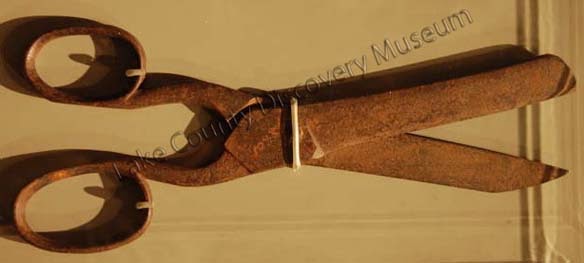
When the roads became passable in the spring of 1859, Lorenz Ott, a tailor by trade, made the young man a suit of clothes as he was about to start a new life in Canada. Wilmot took Jackson to Chicago to board a ship to the north and paid his fare. 
Lorenz Ott's tailor sheers believed to have been used
to make a new set of clothes for Andrew Jackson, circa 1859.
Dunn Museum 64.24.1
It is estimated that at least 30,000 enslaved people escaped to Canada via Underground Railroad networks throughout the North.

During the Civil Warand before the Emancipation Proclamation took effect on January 1, 1863the arrival of Union troops in the South opened a path for enslaved people to find refuge and liberation.

This was the case for James Joice (1822-1872), who settled in Ivanhoe and was featured in a previous post; Henry McIntosh (1843-1915) of Kentucky, who enlisted with the 1st Michigan Colored Infantry 102nd U.S. Colored Troops and settled in Lake Forest in 1871, and worked as a coachman and gardener; and Samuel Dent (ca. 1835 - 1890), who became a surgeon's assistant with the 19th Illinois Infantry, and later settled in Lake Forest. 

Zouaves cadets in their distinct uniforms.
In April 1862, Samuel Dent, attached himself to the ranks of the 19th Illinois Infantry. This Zouave regiment had several officers and sergeants who had belonged to the original company of Ellsworth Zouaves. (See my post on Ellsworth's Zouaves Cadets).

The regiment had advanced on and captured Decatur and Tuscumbia, Alabama, April 11-14, 1862. Dent, who was born in Tuscumbia, Alabama, would have approached the 19th Illinois at this time, seeking freedom and to be of service.

It was also at Tuscumbia that James Davis of Barrington was killed by a sniper. (See my post on the Ghost of the 19th Illinois).

According to a February 1890 article in the Lake Forest College newspaper, The Stentor, Samuel Dent assisted the 19th Illinois' surgeon, Dr. Roswell G. Bogue (1832 - 1893).
Samuel Dent and his livery at the
Chicago and North Western Railroad Depot, Lake Forest.
In the 1870s, Samuel Dent settled in Lake Forest. His decision to come to Lake Forest may have been informed by his experiences with soldiers who were from northern Illinois. Also, Dent may have been aware of Lake Forest's strong abolitionist sentiment, and its growing African-American community, begun in the 1850s. 
Chicago and North Western Depot, Lake Forest, 
circa 1914. Dunn Museum M-86.1.525
Dent started his own livery business, picking up passengers at the Chicago and North Western Railroad depot and taking them to area hotels and homes. He also became a tour guide, pointing out historic sites and the homes of Lake Forest notables. His contemporaries found him to be a charming and generous man.

According to census records, Samuel Dent and his wife Eliza (ca. 1847-19??) had three childrenEliza's daughter, Emma McElroy (1858 - unknown); Charles (ca. September 1879 - May 1880), who died from "cerebral congestion;" and Eliza Jane (1884 - unknown).

When Dent passed away on June 8, 1890, the citizens of Lake Forest subscribed to and erected a monument at his grave to show their "esteem for a lovable Christian, devoted citizen and faithful friend."
Detail of Samuel Dent monument at the
Lake Forest Cemetery.
Special thanks to Laurie Stein, Curator, History Center of Lake Forest - Lake Bluff . 

Sources:

Hahn, Steven, Steven F. Miller, Susan E. O'Donovan, John C. Rodrigue, and Leslie S. Rowland, eds. Freedom: A Documentary History of Emancipation, 1861-1867: Series 3, Volume 1: Land and Labor, 1865. University of North Carolina Press, 2008.

Reichelt, Marie Ward. History of Deerfield, Illinois. Glenview, Illinois: Glenview Press, 1928.

Teters, Kristopher A. Practical Liberators: Union Officers in the Western Theater during the Civil War. Chapel Hill: The University of North Carolina Press, 2018.