
The wrongs of slavery were in the hearts and minds of many prior to the outbreak of the American Civil War in 1861.
 |
"The Underground Railroad" by Charles T. Webber, 1893
Cincinnati Art Museum |
Many citizens of Lake County were antislavery and some even abolitionists. In 1846, the Lake County Anti-Slavery Society was formed in Antioch.
Abolitionists throughout the North organized to aid enslaved people and worked in small, independent groups to maintain secrecy in what was called the Underground Railroad. This informal network of secret routes and safe houses was like an “underground” resistance and used “railroad” terminology.
There are a handful of stories of escaped enslaved people passing through Lake County, and also of freed people settling here after the Civil War (1861-1865).
One of the few detailed stories of
a fugitive enslaved man coming to Lake County was told in the History of Deerfield Illinois by Marie Ward Reichelt (1928). In the winter of 1858, a 28-year old Andrew Jackson arrived from Mississippi at the Deerfield "safe house" of Lyman Wilmot.
Because it was winter and travel was difficult, Wilmot found a more permanent
residence for Jackson at the Lorenz Ott home. Here, Jackson assisted with
chores and built the family a fence around their log cabin home.
 |
The Caspar Ott cabin (above), where runaway enslaved person Andrew Jackson
wintered in 1858-1859, is preserved by the Deerfield Area Historical Society |
When the roads became passable in
the spring of 1859, Lorenz Ott, a tailor by trade, made the young man a suit of clothes as he was about to start a new life in Canada. Wilmot took Jackson to Chicago to board
a ship to the north and paid his fare.
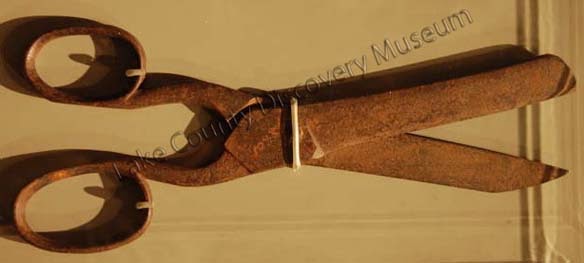 |
Lorenz Ott's tailor sheers believed to have been used
to make a new set of clothes for Andrew Jackson, circa 1859.
Dunn Museum 64.24.1
|
It is estimated that at least 30,000 enslaved people escaped to Canada via Underground Railroad networks throughout the North.
During the Civil War—and before the Emancipation Proclamation took effect on January 1, 1863—the arrival of Union troops in the South opened a path for enslaved people to find refuge and liberation.
This was the case for James Joice (1822-1872), who settled in Ivanhoe and was featured in a previous post; Henry McIntosh (1843-1915) of Kentucky, who enlisted with the 1st Michigan Colored Infantry 102nd U.S. Colored Troops and settled in Lake Forest in 1871, and worked as a coachman and gardener; and Samuel Dent (ca. 1835 - 1890), who became a surgeon's assistant with the 19th Illinois Infantry, and later settled in Lake Forest.
This was the case for James Joice (1822-1872), who settled in Ivanhoe and was featured in a previous post; Henry McIntosh (1843-1915) of Kentucky, who enlisted with the 1st Michigan Colored Infantry 102nd U.S. Colored Troops and settled in Lake Forest in 1871, and worked as a coachman and gardener; and Samuel Dent (ca. 1835 - 1890), who became a surgeon's assistant with the 19th Illinois Infantry, and later settled in Lake Forest.
 |
Zouaves cadets in their distinct uniforms.
|
In April 1862, Samuel Dent, attached himself to the ranks of the 19th Illinois Infantry. This Zouave regiment had several officers and sergeants who had belonged to the original company of Ellsworth Zouaves. (See my post on Ellsworth's Zouaves Cadets).
The regiment had advanced on and captured Decatur and Tuscumbia, Alabama, April 11-14, 1862. Dent, who was born in Tuscumbia, Alabama, would have approached the 19th Illinois at this time, seeking freedom and to be of service.
It was also at Tuscumbia that James Davis of Barrington was killed by a sniper. (See my post on the Ghost of the 19th Illinois).
According to a February 1890 article in the Lake Forest College newspaper, The Stentor, Samuel Dent assisted the 19th Illinois' surgeon, Dr. Roswell G. Bogue (1832 - 1893).
 |
Samuel Dent and his livery at the
Chicago and North Western Railroad Depot, Lake Forest.
Courtesy of Lake Forest - Lake Bluff Historical Society.
|
In the 1870s, Samuel Dent settled in Lake Forest. His decision to come to Lake Forest may have been informed by his experiences with soldiers who were from northern Illinois. Also, Dent may have been aware of Lake Forest's strong abolitionist sentiment, and its growing African-American community, begun in the 1850s.
 |
Chicago and North Western Depot, Lake Forest,
circa 1914. Dunn Museum M-86.1.525
|
Dent started his own livery business, picking up passengers at the Chicago and North Western Railroad depot and taking them to area hotels and homes. He also became a tour guide, pointing out historic sites and the homes of Lake Forest notables. His contemporaries found him to be a charming and generous man.
According to census records, Samuel Dent and his wife Eliza (ca. 1847-19??) had three children—Eliza's daughter, Emma McElroy (1858 - unknown); Charles (ca. September 1879 - May 1880), who died from "cerebral congestion;" and Eliza Jane (1884 - unknown).
When Dent passed away on June 8, 1890, the citizens of Lake Forest subscribed to and erected a monument at his grave to show their "esteem for a lovable Christian, devoted citizen and faithful friend."
 |
Detail of Samuel Dent monument at the
Lake Forest Cemetery.
|
Special thanks to Laurie Stein, Curator, History Center of Lake Forest - Lake Bluff .
Sources:
Hahn, Steven, Steven F. Miller, Susan E. O'Donovan, John C. Rodrigue, and Leslie S. Rowland, eds. Freedom: A Documentary History of Emancipation, 1861-1867: Series 3, Volume 1: Land and Labor, 1865. University of North Carolina Press, 2008.
Reichelt, Marie Ward. History of Deerfield, Illinois. Glenview, Illinois: Glenview Press, 1928.
Teters, Kristopher A. Practical Liberators: Union Officers in the Western Theater during the Civil War. Chapel Hill: The University of North Carolina Press, 2018.
Sources:
Hahn, Steven, Steven F. Miller, Susan E. O'Donovan, John C. Rodrigue, and Leslie S. Rowland, eds. Freedom: A Documentary History of Emancipation, 1861-1867: Series 3, Volume 1: Land and Labor, 1865. University of North Carolina Press, 2008.
Reichelt, Marie Ward. History of Deerfield, Illinois. Glenview, Illinois: Glenview Press, 1928.
Teters, Kristopher A. Practical Liberators: Union Officers in the Western Theater during the Civil War. Chapel Hill: The University of North Carolina Press, 2018.


